

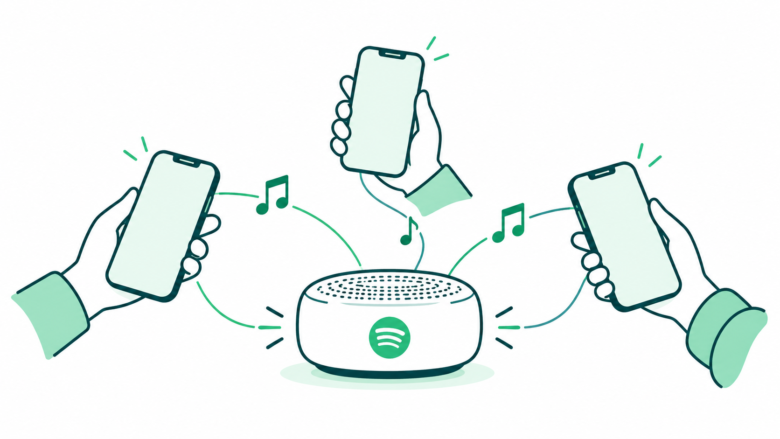
Start with the right listening plan
Use Jam in the current Spotify app. Check the host account, listening mode and output device. Test with one guest, then invite the group. Keep queue access, speaker playback and shared volume as separate checks.
Key Takeaways
- Looking for Spotify Group Sessions? Use the current Jam controls to share a live listening queue.
- You need Premium to host. Free users can join an in-person Jam; remote listeners need Premium.
- Choose the right speaker before inviting friends. Joining a queue and connecting an audio device are separate tasks.
- The host can manage guests and playback controls. Shared volume support depends on the output device.
If you are looking for Spotify Group Sessions, start with Jam in the current Spotify app. Jam lets friends add music to a shared live queue. A Premium user hosts it. Spotify’s current help page allows Free accounts to join in the same room. Remote listeners need Premium.
This page first covered Group Sessions in May 2020. We reviewed and rewrote the guide on October 26, 2026. This update removes the old beta steps. It also drops the unlimited-guest claim and inactivity timer. The steps below use current Spotify sources. Follow the controls on your own device.
Decide where the sound should play before starting. Are you sharing a living-room speaker, or listening from separate homes? That choice changes the setup. It also helps separate Jam problems from speaker problems. You can check one setting at a time.
What to Use for Spotify Group Sessions Today
Jam is Spotify’s current shared listening feature. Spotify introduced it on September 26, 2023, then added desktop support in March 2024. Its launch article describes a live group queue. The host can manage guests and track order. Use that current feature name when you search the app.
Do not expect an old Group Sessions screenshot to match a new app. A menu label can change while an old tutorial remains online. First read the current option on your own screen. If it says Start a Jam, you have found the relevant workflow for this guide.
Separate three roles as you plan. The host starts the session. Guests suggest music. An output device plays the sound. In the same room, that output might be one speaker. For remote listening, each person should check their account. Then review the remote-listening option.
This is a setup guide, not a report of a listening test. We have not measured sound delay between devices or tested every speaker. There is no promise here that separate devices will play in perfect sync. Focus on the documented controls and verify the result with your own small group.
Choose In-Person or Remote Listening First
Think about the listening plan before you send a link. A link by itself does not explain whether everyone should use one speaker or their own audio. Tell guests which mode you intend to use. This avoids a common mismatch between the host’s plan and a guest’s expectation.
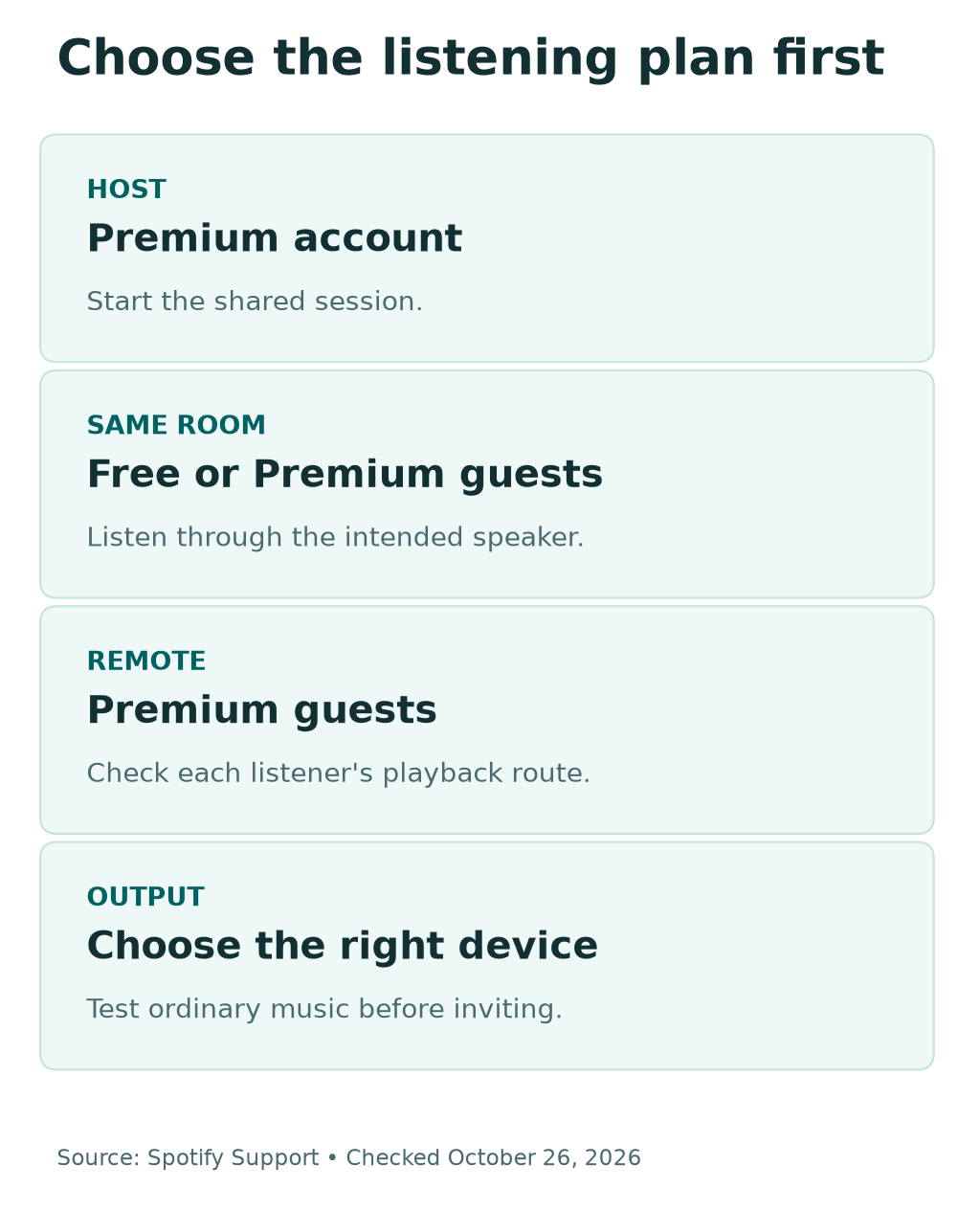
For example, imagine friends cooking in one kitchen. This is a made-up example. One speaker is the intended output, so an in-person Jam fits that plan. Guests add songs from their phones. They do not need to use each phone as another speaker.
Now imagine the same friends in different homes. That is a remote plan. Check remote access before the session. An account limit is easier to address before everyone arrives. A Free guest in the first example does not establish that the same account can join the second one remotely.
Keep the invitation clear and short. State the intended listening mode, the host and when you plan to begin. Never send account passwords as part of the setup. A Jam invitation is the tool for joining the session; it is not a reason to share a login.
| Your goal | Feature or check | Important distinction |
|---|---|---|
| Choose songs for one live group session | Jam | Check host and guest eligibility |
| Hear a phone’s music through a speaker | Bluetooth or Spotify Connect | Audio routing is separate from guest access |
| Build a playlist together over time | Collaborative playlist | Editing a list is different from a live queue |
| Get a shared mix based on music taste | Blend | Recommendations are different from hosting a session |
Start a Spotify Jam on Mobile or Desktop
Spotify offers a device-menu route on mobile. On desktop, use the track or playlist menu. Find Start a Jam, then use Invite to share a link or QR code. Use the route shown in your current app, since layout can vary across screens.
Before opening invitations widely, check that ordinary music playback works. Play a suitable song on the intended output and confirm that you can hear it. If it is silent before anyone joins, solve that first. More guests will make a basic audio problem harder to isolate.
Next, invite one person and ask them to add one track. Check whether it appears in the queue. Keep the first check small. Check that the host, invitation and queue work together. Then you can add more people to the session.
Read the displayed device name before pressing playback controls. Do you have similar speakers in several rooms? A familiar label can still point to the wrong output. Ask someone near the intended speaker to confirm the sound. Do not use loud volume changes as the test.
Once the first guest can add a song and you can hear the intended output, invite the rest of the group. Tell them how you want to use the queue. You might take turns or agree on a broad mood. Those are social choices. They do not guarantee a particular app recommendation.
Join Through a Link, QR Code or Nearby Phone
Spotify offers invitations by link and QR code. It also describes a nearby-phone method with Bluetooth, while logged in, at up to one metre apart. That distance applies to that joining method. It does not mean every remote Jam participant must be within one metre of the host.
Choose a method that fits the situation. A QR code on the host’s screen may suit people in the same room. A direct invitation link may be easier for a friend elsewhere. Use the invitation from the intended host rather than an unrelated screenshot of an old code.
After opening the invitation, review the listening mode before joining. Then add a familiar, suitable track and look for it in the shared queue. If you cannot hear anything, do not assume that joining failed. Check whether this is an in-person queue with sound playing on a shared speaker.
If a link opens the wrong account, stop and check which account the app is using. Do not buy a plan or change account details as a blind fix. Identify the problem first. Use Spotify’s normal support route for account issues. Keep private account details out of public help threads.
Keep Speaker Setup Separate From the Queue
Spotify Connect lets one device control playback on another. Its help page says the devices should share a Wi-Fi network when connecting to a speaker for the first time. Open the device picker and choose the intended output. That establishes where the music should play, rather than who can add songs.
Bluetooth is another audio path. Spotify’s Bluetooth guide starts with pairing through the devices’ Bluetooth settings. Then open Spotify and play. If a speaker fails to pair at all, work on that connection. A fresh Jam invitation will not repair a Bluetooth pairing problem.
Use a simple comparison to narrow the fault. Can you hear a normal song through the phone? Next, try the speaker outside the group session. Does the guest’s track appear in the queue? Each answer checks a different part of the setup. Write down which step fails.
Avoid changing the output, host account and invitation at the same time. If playback begins to work, you would not know which change mattered. Return to a small working setup first, then add the next part. This is a suggested troubleshooting method, not a measured fix rate.
Do several devices have the same name? Read the available details and confirm the physical output. Keep the volume low while testing. Tell the group when you switch devices. Guests can then tell an output change from a broken session.
Understand Host Controls and Volume Limits
The host controls guest access. Guests can be limited to adding songs, without changing playback. Volume sharing is a separate control. Spotify lists shared-volume support for Chromecast and Amazon Cast. Bluetooth and Apple AirPlay do not support that feature. A working queue does not prove that guest volume control should work.
For a group, agree who should adjust volume. If the host keeps that control, tell guests before the session starts. A missing volume option may be expected for the output type. Check that condition first. Do not change the whole audio setup or blame another person’s account.
There are separate permissions for adding a track and changing playback. Speaker volume has its own control too. Decide which matters for your session. A person who can add a song may still lack the volume control they expected. That is a reason to inspect the relevant control, not to reset everything.
For a quiet shared space, one person keeping the volume steady may be useful. For a casual home session, the host may prefer wider control on a supported output. Those are planning examples. Use what suits the people and space, and check the actual device support before relying on a feature.
Manage Invitations and Leave the Session Clearly
Review the guest list when something unexpected happens. Spotify gives the host ways to remove a guest. Its guide also says a host leaving ends the Jam for everyone. Tell the group before ending it. A sudden stop can otherwise look like an app or network failure.
Treat an invitation link as access to the session. Share it with the intended people. Avoid public comments where the audience is unclear. This is practical access advice. It is not a claim that the link exposes an account password or the contents of a private library.
Nearby or same-network invitations can also affect who sees an invitation prompt. Read the Jam settings shown for the current device. If you do not want people nearby to join a speaker session, check the relevant joining control. Avoid assuming that all invitation methods behave like a private message.
At the end, confirm that the session has ended and the intended device is playing what you expect. This is useful when you are leaving a shared speaker behind. A clear handoff helps the next listener. They do not have to guess who controls the queue.
Keep session access separate from account access
Use the intended host’s Jam invitation. Do not share account passwords to let someone join. Review the guest list and current joining controls. Tell the group before the host leaves and ends the session.
Fix Spotify Jam Problems by the Failing Step
If you cannot find the host option, check the account’s Premium status and the app version. Spotify’s update guide provides separate mobile and desktop update steps. Use the official app store or Spotify’s own distribution route. Avoid third-party downloads advertised as a way to unlock the feature.
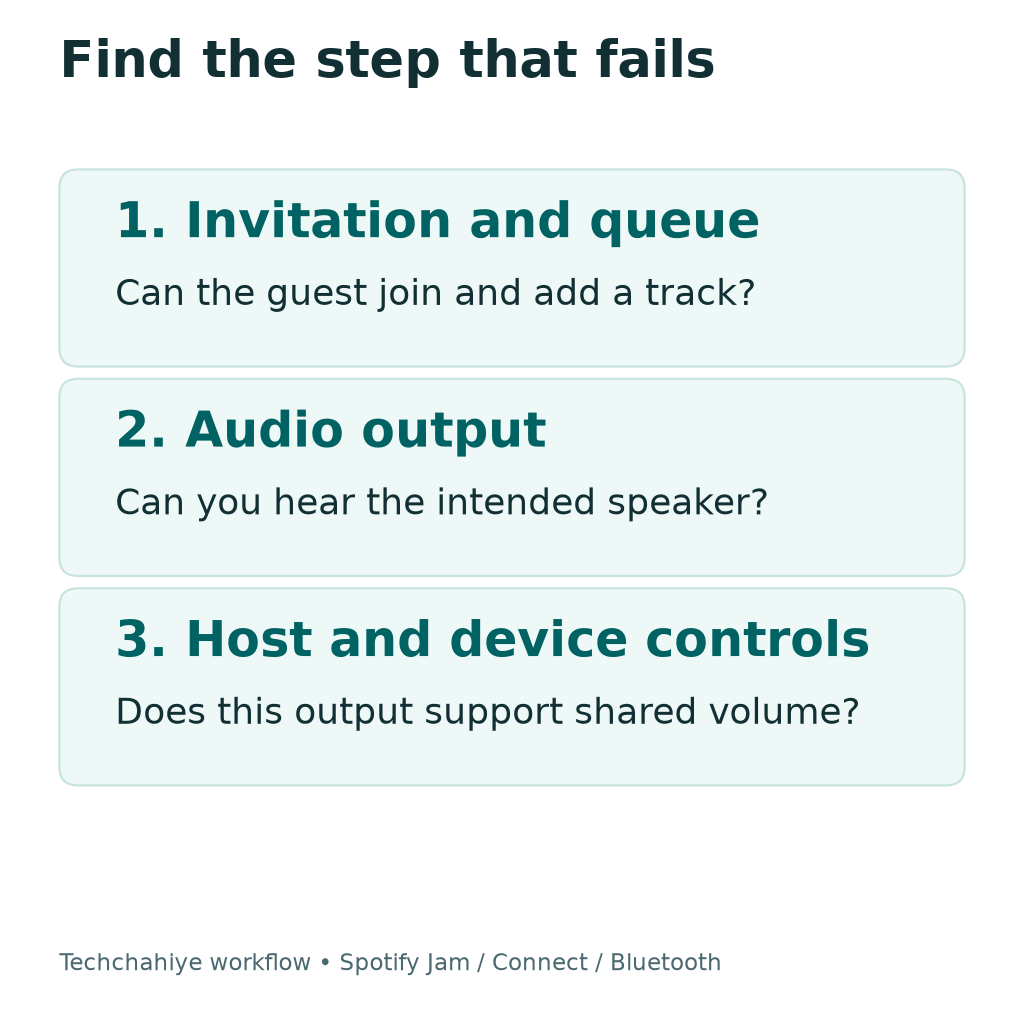
Does an invitation open, but joining fail? Check that the host still has the intended session open. Check the chosen listening mode and which account is active. Note the exact message. “Cannot join” is more useful when you also say whether the failure happens before or after the Join action.
If a guest can add music but hears nothing, check the listening plan and output. In the kitchen example above, the sound belongs on one shared speaker. In a remote session, each guest should review their own playback route. Do not treat those two situations as the same fault.
If the speaker is missing, follow the relevant Connect or Bluetooth help. Spotify’s Connect guidance includes restarting the app and device. It also covers software updates and network checks. Make one change at a time and try ordinary playback again before adding the group workflow back.
If only volume sharing fails, check device support and the host’s control. A Bluetooth speaker can play music while lacking that specific shared-volume feature. New invitations cannot add shared volume to an output that lacks it.
If the issue persists, collect a short support note. Include the app version, device model and output type. Add the listening mode and exact failed step. Include an error message if one appears. Keep private details out of public screenshots. That includes invitation links, account details and other people’s information.
Choose a Collaborative Playlist or Blend When It Fits
A live queue is not the only way to choose music together. Spotify’s guide describes shared playlist editing. Invited people can add, remove and reorder tracks. That suits planning over time. For example, friends can prepare a trip playlist without all meeting in one live session.
Spotify says collaborator invitation links last seven days. If an old invitation fails, check whether it has expired. Leave unrelated account settings alone. Review collaborators when the group changes. A past invitation may no longer match who should edit the list.
Blend serves a different purpose. Spotify describes a shared playlist based on the group’s listening. It updates daily. Its current guide allows invitations to up to ten friends. Choose it when you want a taste-based mix, rather than a host deciding the flow of a live session.
These choices can solve different parts of a plan. A group might prepare a collaborative playlist beforehand. Then they can use a Jam when together. This is an example workflow. It does not mean one feature converts into the other. Check the actual playlist and session you mean to use.
Use Jam on a TV or in a Car With the Right Context
Spotify’s current guide includes in-person Jam controls for TV, Android Auto and CarPlay. The intended sound comes from the TV or car speakers. That does not promise remote playback on every screen. It is not general speaker-mirroring support.
For Android Auto, Spotify lists version 14.5 or later and Spotify app version 9.0.50 or later. Spotify lists these as minimums. Do not downgrade a newer app to match them. Read the current guide for your setup. Keep the phone and in-car software on supported versions.
Set up the listening plan while parked. Let a passenger handle guest invitations and queue choices during a trip. This keeps the workflow practical without asking the driver to manage phone menus. If the car is not part of your plan, the mobile and desktop paths above are enough.
Did You Know?
Spotify added Jam to desktop in March 2024, according to its updated launch article. If an old guide tells you the shared-session feature is only a mobile beta, that description is out of date. Check today’s Jam controls and account requirements. Do not follow the old screenshot word for word.
Conclusion
For Spotify Group Sessions today, use the current Jam workflow. Choose the listening mode first. Confirm the host’s account. Test ordinary playback on the intended output. Then invite one person before expanding the group. Keep queue access and speaker controls separate while you troubleshoot.
Finally, choose the feature that matches the task. Use Jam for a live session, a collaborative playlist for shared editing, or Blend for a taste-based mix. If a step fails, note that exact step and consult the matching Spotify help page in References.
FAQs
Where are Spotify Group Sessions in the current app?
Look for Start a Jam in the current Spotify device or track and playlist menus. This guide updates the older Group Sessions instructions with today’s Jam workflow. Menu layout can vary by device, so follow the current app rather than an old beta screenshot.
Can a Free user join a Spotify Jam?
Yes, for an in-person Jam hosted by a Premium user, according to Spotify’s current help. Remote participation needs Premium. Check the intended listening mode before deciding whether an account meets the requirements.
Why can I add songs but not change the speaker volume?
Queue access and shared volume are different controls. The host must allow volume sharing on a supported output. Spotify supports this on Chromecast and Amazon Cast. Bluetooth and Apple AirPlay lack the shared-volume feature.
What happens when the host leaves a Jam?
Spotify says the Jam ends for everyone when its host leaves. Tell guests before ending it. They can then tell a planned stop from a connection problem. Review the current device and queue after the session ends.
Is Jam the same as a collaborative playlist?
No. Jam is for a live shared listening session. A collaborative playlist lets invited people edit a stored playlist over time. Use the playlist to prepare tracks together over time. Use Jam to control a current session.
References
- Spotify Support — Start or join a Jam
- Spotify Newsroom — Introducing Jam, with desktop and car updates
- Spotify Support — Spotify Connect
- Spotify Support — Bluetooth help
- Spotify Support — Updating your Spotify app
- Spotify Support — Collaborative playlists
- Spotify Support — Social recommendations and Blend
- Techchahiye — Apps and productivity guide
- Techchahiye — Websites for listening to music online
